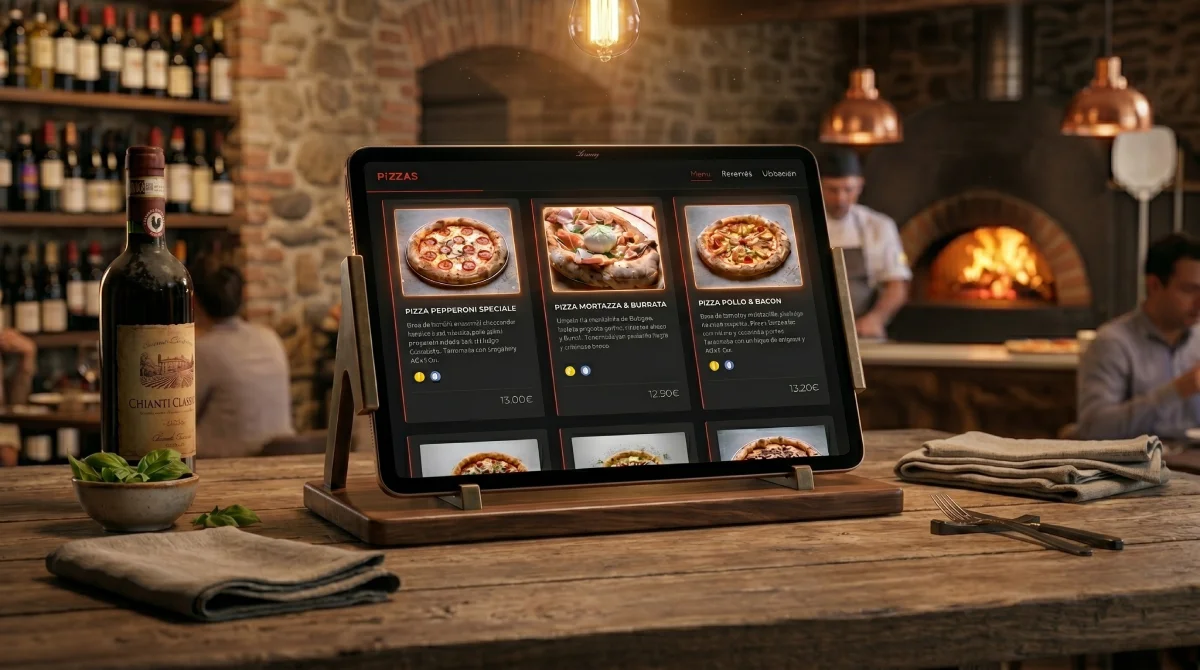
* Average data for dishes positioned in hot zones on QueAproveche menus.
- What is menu engineering and its impact on hospitality
- The trap of PDF and paper: customers who choose by price
- Hot zones and how to locate your Star dishes
- The power of the image: Visual hunger with instant loading
- Agile editing in 10 seconds: React on the fly
- Conclusion: Your menu as your most efficient salesperson
What is menu engineering and its impact on hospitality
Menu engineering is a Gastro-Marketing discipline that analyses the profitability and popularity of restaurant dishes to design their visual layout. Its objective is not to decorate the menu, but to directly influence consumer behaviour to direct demand towards the most lucrative options.
Traditionally, this study classified dishes into four quadrants: Star (high popularity, high margin), Plowhorse (high popularity, low margin), Puzzle (low popularity, high margin), and Dog (low popularity, low margin). The challenge has always been how to visually guide the diner to choose the Star dishes.
The trap of PDF and paper: customers who choose by price
When you hand over a physical paper menu or a fixed PDF file using a generic QR code, you are drastically limiting your venue's sales potential. In these static formats, the customer typically behaves predictably: they run a quick scan comparing prices from top to bottom and, by inertia, choose looking for the cheapest option.
Furthermore, a PDF forces users to constantly zoom in and out on their mobile screens, breaking the visual experience and causing friction. The customer buys based on the price factor because the presentation lacks emotional stimuli and tactile flexibility.
Por eso la solución más rentable es dar el salto a un estrategias de upselling pasivo con carta QR.
Hot zones and how to locate your Star dishes
In web and mobile environments, design rules change in our favour. Screen hot zones (where the user rests their eyes in the first few seconds) are located at the top and in the starting positions of each category.
With an interactive menu, you can position your Star dishes (those with the best profit margin for your business) at the beginning of each section, or create a highlighted category like 'Chef's Suggestions' or 'Our Favourites'. By giving them spatial and visual priority, you increase the likelihood of selection without the diner feeling pressured.
- First elements: Place your most profitable specialties at the start of each section's list.
- Visual badges: Add badges like 'Recommended' or 'House Favourite' to draw the eye.
- Avoid price pain: Display prices in an integrated way but without prominent currency symbols (€), softening the spending experience.
The power of the image: Visual hunger with instant loading
Human beings buy with their eyes. In hospitality, 'visual hunger' is an immediate psychological trigger. However, adding high-resolution photos to a website usually comes with a heavy technical cost: it slows down the website, frustrating customers with endless loading spinners.
To resolve this, QueAproveche's Auto-Compression technology automatically processes every image you upload. It optimises them to the exact screen size and reduces their weight without losing a single drop of quality, ensuring they load in 0ms.
The result is instant: the customer immediately sees the colour of the tartar, the texture of the melted cheese, or the detail of the homemade dessert. Fast photos translate to fast, emotional purchase decisions.
Start monetising your digital menu
Design your smart menu in minutes, highlight your star dishes, and increase your average ticket by 20%. Try it free for 30 days, no credit card required.
Create free digital menuAgile editing in 10 seconds: React on the fly
Menu engineering is not a static process done once a year. It requires experimentation: if a Puzzle dish isn't selling, maybe it needs a name change, a better photo, or to be moved higher up in the list.
With QueAproveche, you don't depend on designers, agencies, or programmers. You can access your control panel from your own phone, change the order of dishes by dragging them with your finger, or modify a price in less than 10 seconds.
If you run out of stock of an ingredient on a Saturday night, you can hide it instantly to avoid disappointments. If you want to test whether a new dessert sells better at the beginning of the section, you can move it on the fly.
Conclusion: Your menu as your most efficient salesperson
Digitalisation properly understood is not simply replacing physical media with a screen; it is using technology to sell intelligently.
By applying menu engineering techniques to a fast, attractive, and flexible interactive menu, you turn your digital menu into your most efficient waiter: one that never forgets to suggest pairings, always highlights the most profitable items, and serves visually in 0 milliseconds.